
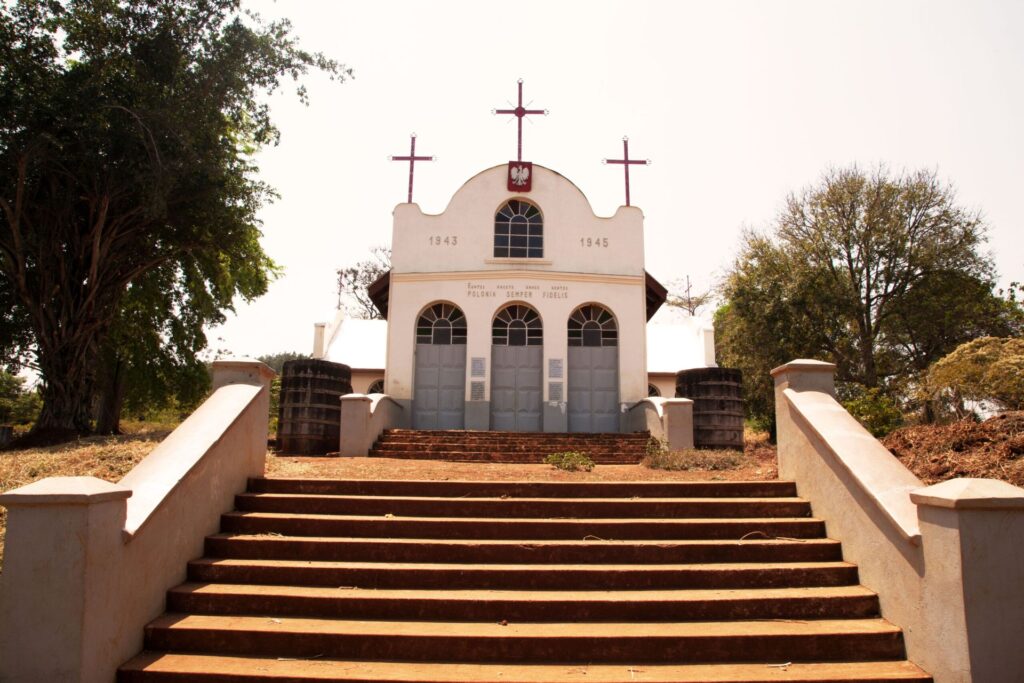
Situated in Nyabyeya, near the Masindi region, this Polish church is also known as Our Lady Queen of Poland Catholic Church in Uganda. It was built between 1943 and 1945 by refugees who traced their roots back to Poland and sought safety in the region.
The church was constructed on top of Wanda Mountain and has inscriptions in four languages: English, Polish, Latin, and Kiswahili.
The church is significant because it was built as a special tribute to the Blessed Virgin Mary, who was considered the queen of Poland at the time.
The exiles and refugees who were searching for a free homeland created Polish phrases and a coat of arms, which were engraved at the church’s entrance.
The inscription at the door reads “Poloniae semper Fidelis.” Inside the chapel, there are other inscriptions that are different from those at the entrance.
These are written beneath the Stations of the Cross and the image of Our Lady of Czestochowa. Until 1948, when the refugee camp was closed, the church played an important role in helping Polish citizens.
The Polish Cemetery in Masindi, Uganda

Next to the church, which now serves the local community, is a Polish cemetery with around forty gravestones still standing.
A plaque at the cemetery reads, “Pray for Poles who died between 1939 and 1947.” In 2010, a group of students from the Pedagogical University of Krakow helped renovate the cemetery.
This Polish Catholic Church, located near Nyabyeya College, is unique because it was built mainly by refugees, most of whom were women.
During the Second World War (1939 to 1947), the men and women who designed and constructed the chapel were said to have fled Europe.
It is a fact that in the 1940s, about 2,000 Polish women, children, and elderly men arrived in western Uganda. More than 18,000 other Poles sought safety in 22 African countries.
Before being released under an amnesty in 1941, the Poles who sought refuge in Masindi had been imprisoned in Siberian prisoner-of-war camps.
The physically strong Polish men were recruited into the army, while those unable to fight were forced to seek refuge in British overseas territories.
After more than 110,000 people migrated from the Russian steppes to countries like Iraq, Iran, Palestine, and India, the Poles who were destined for Uganda arrived by boat in Mombasa.
From there, they traveled by train through Kenya and were later transported to Masindi district and Lake Kyoga.
It is surprising but true that this Polish Catholic Church in Uganda was built mainly by women who had been forced to leave their husbands fighting in the 1939 to 1947 war.
Apart from its religious importance, the Polish Catholic Church in Uganda holds great historical value for Polish people. There are 51 graves in the cemetery at the church.
Beside the graves, inscriptions on the church walls and images of “The Way of the Cross” tell the story of the suffering and sacrifice of Jesus.
The inscription, “Pray for Poles who died between 1939 and 1947,” serves as a reminder of Poland’s history.
Polish Refugees in Masindi

“Masindi is a large village built especially for the reception of Polish refugees,” said Stanislaw Lula, one of the first Poles to arrive in Uganda at the age of sixteen.
Masindi was established in 1942 and consisted of eight connected communities. “Our village was called Monkey Grove because it was next to a bush that was home to a large number of monkeys.”
For a deeper understanding of the experiences of the Polish people in this community, one might read Barbara Parajska’s book “From the Steppes to the Savannah.”
In 1945, World War II ended. The British started closing the refugee camps in 1948. Out of the 18,000 Poles who had traveled from Siberia to East Africa, only 3,000 returned to Poland.
The rest moved to other countries.
This church continued to serve the Polish community in Uganda until the camp was closed in 1948.
Related Article: Batwa Cultural Tours in Uganda - Experience the Rich Heritage of the Batwa Pygmies


